When to Escalate and When to Absorb
There’s a moment most small contractors recognize but rarely talk about.
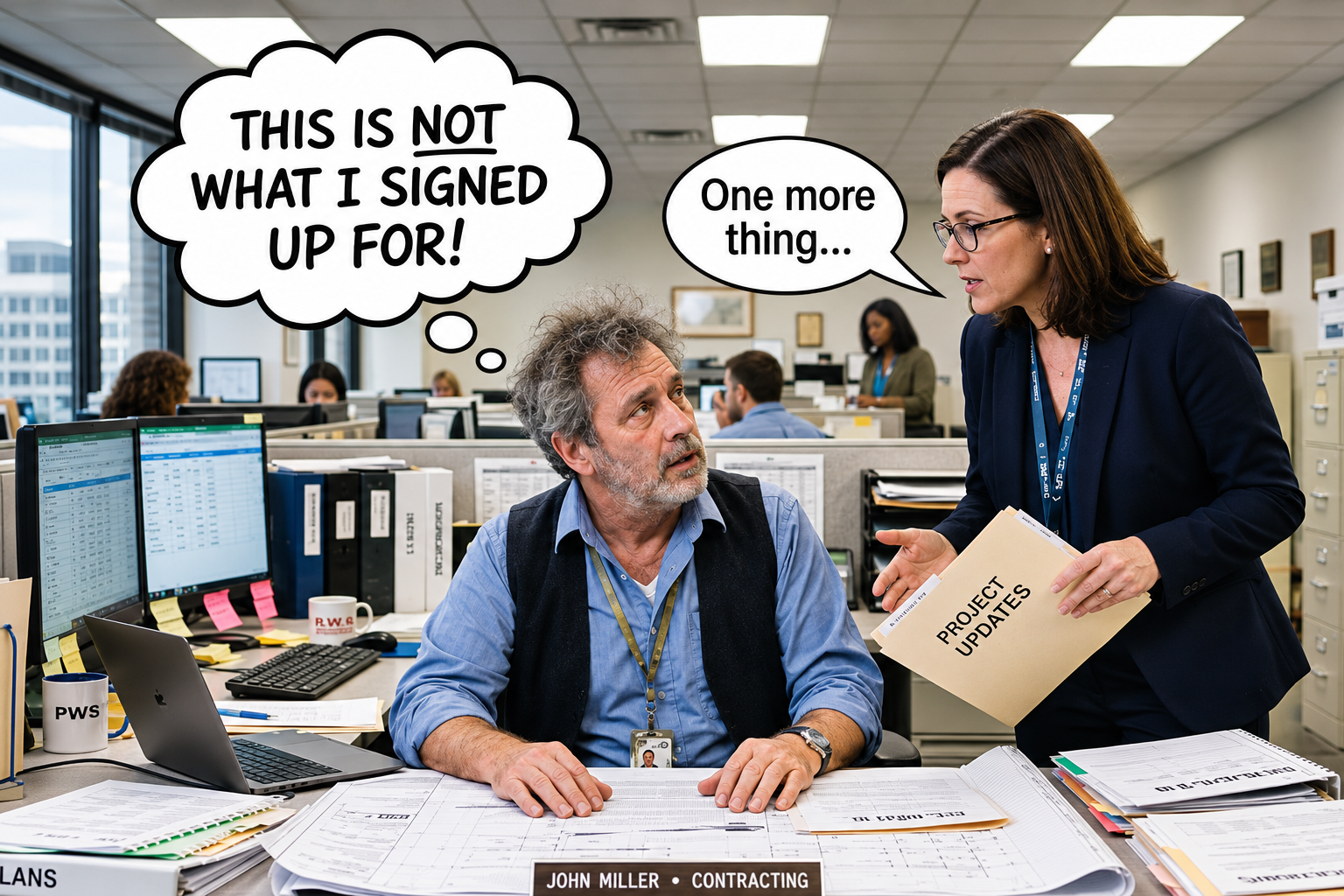
It’s not a dramatic confrontation or a formal dispute. It’s quieter than that. It’s the moment you realize you’ve been saying yes for so long, to the extra task, the informal request, the scope that keeps expanding at the edges, that pushing back now feels impossible. The relationship has shifted somewhere along the way and you’re not sure exactly when it happened. You just know that what started as a manageable contract has become something heavier than what you signed up for.
If that sounds familiar, you’re not alone. And the instinct that got you there - keep your head down, protect the relationship, don’t be the difficult contractor - is completely understandable. It’s also quietly costing you more than you realize.
Why Small Contractors Default to Absorbing
The tendency to absorb rather than push back isn’t weakness. It’s rational behavior given the power dynamics of government contracting.
The contract matters too much to risk. The contracting officer holds significant influence over your past performance ratings. You’re a small business without a legal team on retainer, and the last thing you want is a reputation for being difficult to work with. The follow-on contract, the one you’ve already started positioning for, feels like it hangs in the balance of every interaction.
So you absorb. You say yes to the informal request that stretches your scope. You accommodate the timeline change that costs you a weekend. You let the verbal direction that contradicts your PWS slide because raising it feels like making an accusation.
Each individual decision is defensible. The cumulative effect is a trap.
The contractor who absorbs everything trains the people they work with to expect it. What felt like relationship preservation in month two becomes an unsustainable baseline by month eight. And by then, the gap between what your contract says and what you’re actually doing has grown wide enough that addressing it feels like starting a fight.
What Absorbing Actually Costs You
The price of never pushing back is real, and it shows up in places that matter.
The most immediate cost is margin. Scope creep is rarely dramatic; it’s a recurring small request here, an expanded deliverable there, an informal add-on that seemed reasonable in the moment. Each one is manageable. Together they erode the financial logic of the contract quietly and steadily until you’re performing significantly more work than you’re being paid for.
The second cost is your staff. When the workload expands without a contract adjustment, the people doing the work absorb the difference. In facilities and janitorial contracting specifically, where labor is your primary cost and your primary risk, that margin compression shows up fast in turnover, burnout, and service quality.
The third cost is the one most contractors don’t anticipate: the pattern itself becomes a signal. A CO or prime who sees that you’ll accept anything (expanded scope, informal direction, timeline pressure without adjustment) will continue to apply it. You’ve communicated, through your behavior, that you’ll absorb whatever comes.
And the follow-on you were trying to protect? A contract that quietly went sideways, even if you delivered through it, doesn’t set you up the way a cleanly managed contract does.
Understanding What’s Actually Escalatable
Not everything is worth escalating. Part of managing CO relationships well is knowing the difference between friction that’s normal and friction that requires a response.
Some things are worth absorbing. Minor miscommunications, one-off requests that are reasonable and within the spirit of the contract, small timeline accommodations on low-stakes items, personality differences that don’t affect performance, these are the texture of any working relationship. Escalating every minor irritant damages the relationship without protecting the contract.
Some things are worth documenting and monitoring without immediate escalation. Recurring requests that push the edges of your scope. Verbal direction that seems to conflict with your PWS. Informal pressure to perform work that isn’t clearly covered. These don’t necessarily require a formal response right away, but they require a paper trail and close attention. A pattern that’s documented early is manageable. A pattern that’s ignored becomes a dispute.
Some things require escalation. Written direction that conflicts with your contract terms. Scope additions being requested without a contract modification. Safety issues. Payment delays beyond your contract terms. And, critically, any suggestion that your past performance rating will be affected by your response to requests outside your contract scope. These are not relationship issues. They are contract issues, and they require a contract response.
The key distinction is this: escalation isn’t about the relationship. It’s about the contract. Keeping those two things separate in your own thinking makes the decision clearer.
How to Escalate Without Burning the Relationship
The fear that escalating will damage your relationship with a CO is understandable but often overstated. A professionally handled escalation, one that addresses the contract issue without making it personal, rarely damages relationships the way contractors fear it will.
Start with documentation, not confrontation. Before you raise anything formally, make sure you have a clear record of what was requested, when, and how it relates to your contract terms. A paper trail protects both parties and gives you something concrete to reference when you do have the conversation.
Use the clarification email as your primary tool. Instead of “you’re asking me to do something outside my scope,” try “I want to make sure I’m handling this correctly, based on my reading of the PWS, this request falls outside section X. Can we discuss how to address it?” You’re framing the issue as a question you need help answering, not an accusation you’re leveling. That framing matters.
Escalate to the issue, not the person. The CO isn’t the problem. The gap between what the contract says and what’s being requested is the problem. Keep your language focused there.
Know your chain of command and when each level is appropriate. Most issues start and end with the CO. If a CO is unresponsive or the issue involves the CO directly, understand when the Procuring Contracting Officer, Administrative Contracting Officer, or agency ombudsman becomes the right contact. Using the chain correctly signals professionalism. Jumping it signals panic.
And escalate early. The moment something first appears that seems outside your scope is the right time to raise a gentle clarification. Waiting until it has become a pattern, or until you’re already resentful about it, makes the conversation significantly harder.
The Documentation Habit That Makes Everything Easier
Underneath all of this is one practice that makes escalation less dramatic and absorption less dangerous: document everything, consistently, from day one.
Every verbal direction gets confirmed in a brief email summary. Every request that stretches the edges of your scope gets logged with a date and description. Every deviation from your PWS gets noted.
This isn’t adversarial. Frame it to yourself and to your team as professional contract management, which is exactly what it is. Contractors who document consistently rarely need dramatic escalations because small issues get addressed before they compound into large ones. And when escalation does become necessary, the documentation makes the conversation cleaner and faster for everyone involved.
The CO who gives you informal direction and then receives a brief “just confirming our conversation from this morning” email is not being accused of anything. They’re working with a contractor who runs a tight ship. That reputation is worth building.
The Bottom Line
Knowing when to escalate isn’t about being difficult. It’s about being professional.
The CO relationship is a working relationship, not a power dynamic you have to survive by saying yes to everything. Contractors who manage it well, who absorb what’s reasonable and escalate what isn’t, tend to produce cleaner contracts, clearer records, and stronger past performance ratings than the ones who quietly absorb everything and hope for the best.
The goal isn’t to win every dispute. It’s to run a contract you can be proud of, and get paid fairly for the work you actually do.