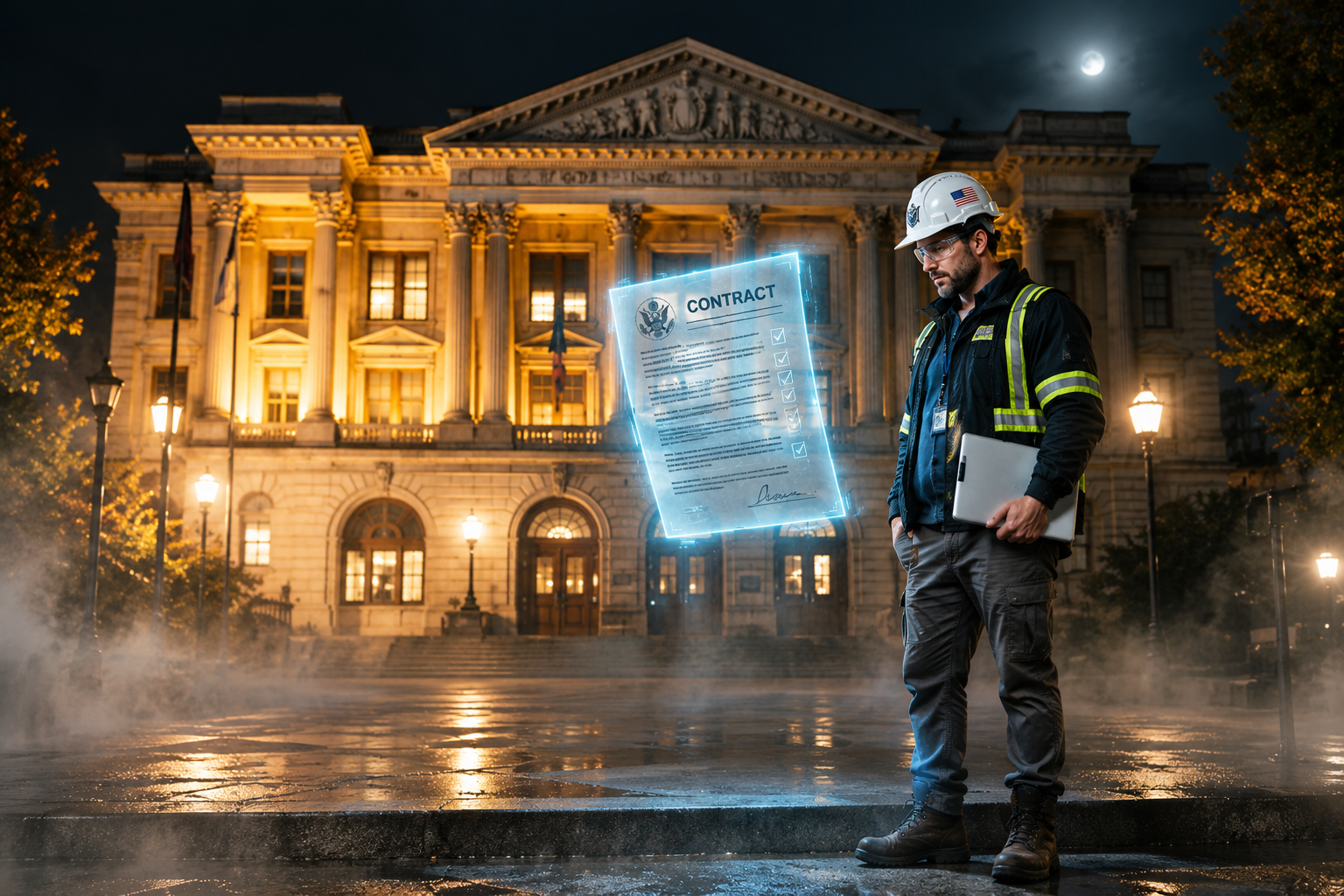
The Haunted Solicitation
You know the feeling.
You found an opportunity that fit perfectly. The scope matched your capabilities. The NAICS code was yours. You spent real time on the proposal: pulled your past performance together, wrote a tight technical approach, checked every box in the instructions. You submitted with cautious confidence.
Then you lost.
The debrief was vague. The scores didn’t quite add up. The winning contractor was the incumbent, and the evaluation narrative read like it had been written around their specific approach rather than the evaluation criteria. Something felt off. You couldn’t name it exactly, but the feeling stuck, like you’d been competing in a game where someone else already knew the outcome.
There’s a term for what you experienced. In government contracting circles, it’s called a wired contract. And this Halloween, we’re pulling back the curtain on one of the most persistent ghost stories in the small business govcon world, the solicitation that looked alive but was already spoken for before it ever posted.
What a Wired Contract Actually Is
Let’s start with a clear definition, because the term gets thrown around loosely and it covers a lot of ground.
A wired contract is an informal term for a procurement that has been shaped, intentionally or through incumbency advantage, to favor a specific contractor before competition opens. It exists on a spectrum. On one end sits outright improper conduct: a contractor who helped write the SOW, a CO with an undisclosed relationship, requirements engineered specifically to exclude competition. On the other end sits something entirely legal: an incumbent whose years of strong performance have made them the obvious choice, and a solicitation that reflects what the agency already knows works.
Most wired contracts aren’t illegal. They’re the result of relationships built over time, prior performance that agencies trust, and pre-solicitation influence that the Federal Acquisition Regulation doesn’t prohibit. Understanding that distinction matters, not because it makes losing feel better, but because it changes how you respond.
What we’re talking about here isn’t corruption. It’s a market reality. And like most market realities, it’s navigable once you understand how it works.
How Solicitations Get Shaped Before They Post
The procurement process has a pre-solicitation phase that most small contractors underinvest in, and that’s exactly where solicitations get shaped.
Incumbents often have access to agencies during requirements development that outside contractors don’t. Sometimes this is formal: an agency asks a current contractor for input on what the next contract should look like. Sometimes it’s informal: years of working relationship means the agency’s requirements naturally reflect how the incumbent does the work. Either way, the result is a Statement of Work that fits one contractor’s capabilities more precisely than it fits anyone else’s.
Pre-solicitation engagement (e.g., responding to Sources Sought notices, attending industry days, requesting meetings with contracting officers) gives contractors the opportunity to influence how requirements get written. The agencies that run robust pre-solicitation processes tend to produce more competitive solicitations. The ones that skip it tend to produce solicitations that look like they were written by the incumbent. Sometimes they were.
Past performance requirements are another lever. A solicitation that requires “demonstrated experience performing X service at Y scale for a federal agency within the last three years” isn’t necessarily improper, but when the threshold matches the incumbent’s contract almost exactly, it effectively screens out qualified competitors before the evaluation begins.
None of this is always intentional. Agencies default to what they know works. Contracting officers are busy and risk-averse. Writing requirements around a proven contractor is, from their perspective, a reasonable way to reduce procurement risk. Understanding their logic doesn’t mean accepting the outcome, it means knowing what you’re dealing with.
The Five Signals Worth Looking For
Here’s where it gets practical. Before you invest serious time in a pursuit, run it against these five signals. No single one is disqualifying on its own. In combination, they paint a picture worth paying attention to.
The SOW reads like someone’s capability statement. Requirements that are hyper-specific in ways that only benefit one type of contractor, particular equipment brands, specific service delivery methodologies, unusual certifications that aren’t standard in your industry, suggest the requirements were written with a specific provider in mind. The more specific and unusual the requirements, the more worth asking who they were written for.
The response window is unreasonably short. A ten-day turnaround on a complex solicitation isn’t an accident. Short response windows favor incumbents who already have their documentation assembled and disadvantage outside competitors who need time to build a competitive response. When a solicitation drops on a Friday afternoon with a response due the following Wednesday, that’s a signal.
Past performance requirements are suspiciously calibrated. Pay attention to the specificity of past performance thresholds. “Must have performed custodial services for a federal facility of at least 50,000 square feet within the past three years” is a legitimate requirement. “Must have performed custodial services for a Department of Defense readiness facility of at least 47,000 square feet using an integrated quality control system within the past three years” is a description of someone’s specific contract history.
No pre-solicitation engagement preceded it. A solicitation that appears without a prior Sources Sought, industry day, or request for information suggests the agency wasn’t interested in market feedback. Agencies that already know what they want, and who they want, tend to skip the pre-solicitation process. Its absence is a signal worth noting.
The incumbent is well-known, well-liked, and well-connected. This one requires nuance. Incumbent advantage is real and often legitimate. An agency that has worked with the same contractor for six years and received consistently strong performance has every reason to favor that contractor’s continuation. The question isn’t whether the incumbent has an advantage, they almost always do, it’s whether the solicitation was structured to make competition meaningful or to make it theatrical.
The Difference Between Wired and Won
This is the nuance that matters most, and it’s worth sitting with.
Not every incumbent advantage is a wired contract. Incumbents win recompetes at high rates for legitimate reasons. They know the facility. They know the COR. They’ve solved the problems that only show up after month three of a contract. Their past performance record in that specific context is genuinely stronger than any outside competitor’s.
The question to ask honestly before you commit to a pursuit isn’t “does the incumbent have an advantage?” They almost certainly do. The question is: can a qualified non-incumbent realistically win this, and is there evidence in the solicitation structure that a real competition was intended?
If the SOW mirrors the incumbent’s capabilities, the past performance thresholds match their contract history, the response window is tight, and there was no pre-solicitation engagement, the honest answer may be no. And that’s a legitimate bid/no-bid input, not a reason to feel cheated.
What to Do When You Spot the Signals
Recognizing a haunted solicitation doesn’t mean walking away empty-handed. It means making better decisions about where your time goes.
Factor it into your bid/no-bid decision honestly. Chasing wired opportunities costs real money and real time, proposal preparation, staff hours, subcontractor conversations. Every proposal you write for an opportunity you can’t realistically win is a proposal you didn’t write for one you could.
Know that pre-award protests exist. If the signals are strong enough, requirements that appear to be written around a specific contractor, evaluation criteria that seem designed to exclude qualified competition, the Government Accountability Office (GAO) and Small Business Administration (SBA) both have mechanisms for challenging solicitations that appear improperly structured. Most small businesses never use these. They exist for exactly this situation.
Use it as intelligence. A haunted solicitation is a map. It tells you who has the relationship you don’t yet have, what the agency values, and what you’d need to build to be competitive next time. That’s genuinely useful information if you treat it that way.
Start showing up earlier. The contractors who influence solicitations are the ones who responded to the Sources Sought eighteen months ago, attended the industry day, and requested a capability briefing with the CO before requirements were written. You can’t win the pre-solicitation phase of a contract you weren’t present for.
The Longer Game
Every haunted solicitation is an invitation to ask a harder question: why wasn’t that us?
The contractors winning consistently in any agency aren’t just better at writing proposals. They’re present before the solicitation exists. They’ve built the relationships that make them the known quantity, the contractor the CO thinks of when requirements are being developed, the one whose approach naturally shapes what gets written into the SOW.
Incumbent status isn’t permanent and it isn’t magic. It’s the result of showing up early, performing well, and maintaining relationships between contract cycles. The contractor who loses a haunted solicitation today can be the one the next solicitation is written around, if they start doing the work of pre-solicitation engagement now.
The Bottom Line
Haunted solicitations are real. They’re more common than anyone officially acknowledges, and most small contractors have lost to one without fully understanding what happened. The debrief felt thin. The scores didn’t quite make sense. The incumbent won again.
Now you have a name for it, and more importantly, a framework for spotting it before you invest weeks in a proposal that was never really a competition.
The good news about ghosts is that once you can see them, they lose most of their power. Stop spending proposals on opportunities that were never really available. Start spending that energy on the ones that are,and on building the relationships that make the next solicitation yours to lose.
Happy Halloween. 🦇